Driving Quality
RC Toy Wheel Runout and Straight Tracking Checks
Straight tracking is the result of a complete wheel, axle, chassis and steering system under defined driving conditions. Wheel runout should be assessed separately from controller trim and normal toy-grade steering tolerance.
Direct answer: Standardize the surface, battery and control setup, observe wheel rotation and path, then diagnose the component or assembly source before setting acceptance criteria. This guide is written for importers, distributors, retailers and private-label teams that need to make a defensible buying decision before they approve an RC toy sample or release an order.
How procurement teams should use this guide
Buyer situation: Buyers need a repeatable way to evaluate visible wheel wobble and whether an RC vehicle drives acceptably straight. Tracking depends on tires, wheels, axles, steering trim, surface and assembly, so a vague straight-line requirement creates disputes.
Use the sections below as a discussion framework for the exact product and destination, not as a universal specification. Begin with the approved vehicle, controller, battery, accessories and packaging revision. Mark each point as confirmed, open, not applicable or requiring specialist review, then assign an owner and due date. Evidence should identify the model and production version it covers. When a supplier answer depends on an early sample, a related product or an assumed market rule, keep the point open until the relevant production record, qualified adviser or official source supports the decision. This approach turns research into a controlled sourcing action without implying that one checklist replaces engineering, laboratory, legal, customs or transport expertise.
Good RC toy sourcing is a connected process. Product application, customer requirements, factory testing, packaging preparation and shipment inspection all need to point to the same approved configuration. The practical objective is not to add paperwork; it is to make decisions clear enough that the factory, buyer and logistics partners can act without guessing.
Use these articles alongside our RC toy product range, Shenzhen factory overview and quality-control process to turn a buying question into a project brief.
For the connected buying decisions, see RC Toy Supplier Communication and Order Tracking: B2B Guide, RC Toy Quality Inspection and Defect Checks: Buyer Guide, RC Stunt Car Mechanisms: Durability Checks for Buyers.
1. Define the driving setup
Use a clean, level and repeatable surface with a stated lane length and vehicle starting position.
Carpet pile, tile joints and floor slope can change the path of a lightweight RC toy. Record battery state, controller trim and speed mode. Decide whether the check uses a brief forward run, forward and reverse, or a model-specific routine. The method should be practical for the product category and not imply precision expected from a different grade of vehicle.
During factory testing and shipment preparation, use define the driving setup as a named handoff. Record the agreed condition, identify the person who checks it, and keep the result with the project file. This does not need to become a complicated report: a controlled product specification, dated sample photos, a packing reference and a short inspection record are often enough to make customer requirements traceable. The important point is that a later sample change, production question or buyer request can be checked against a visible reference rather than memory.
Buyer check
Before moving forward, ask the supplier to show how this point is captured in the product brief, approved sample record, production preparation or shipment inspection plan. A clear answer should name the reference, the responsible person and the timing of the check. If the answer cannot be tied to an approved configuration, treat it as an open decision rather than an agreed production instruction.
2. Center the steering system
Confirm transmitter trim, servo or motorized steering position and linkage assembly before judging the path.
A controller left off-center can create a false defect. Inspect neutral wheel direction with the vehicle powered as intended. If the design provides user trim, define the factory setting and instruction. Excessive correction needed to drive straight may indicate assembly variation even when the toy can be adjusted by the consumer.
During factory testing and shipment preparation, use center the steering system as a named handoff. Record the agreed condition, identify the person who checks it, and keep the result with the project file. This does not need to become a complicated report: a controlled product specification, dated sample photos, a packing reference and a short inspection record are often enough to make customer requirements traceable. The important point is that a later sample change, production question or buyer request can be checked against a visible reference rather than memory.
Buyer check
Before moving forward, ask the supplier to show how this point is captured in the product brief, approved sample record, production preparation or shipment inspection plan. A clear answer should name the reference, the responsible person and the timing of the check. If the answer cannot be tied to an approved configuration, treat it as an open decision rather than an agreed production instruction.
Share your target market, product category and expected quantity for a focused recommendation.
3. Observe wheel and tire runout
Rotate or drive the wheels and distinguish rim, axle, hub and tire seating effects.
A soft tire can appear irregular when the bead is not seated. A bent axle or eccentric molded wheel creates a different pattern. Check for foreign material and overtightened retention. Use visual reference samples or an appropriate gauge for critical programs. Avoid forcing wheels by hand in a way that damages gears or misrepresents powered rotation.
During factory testing and shipment preparation, use observe wheel and tire runout as a named handoff. Record the agreed condition, identify the person who checks it, and keep the result with the project file. This does not need to become a complicated report: a controlled product specification, dated sample photos, a packing reference and a short inspection record are often enough to make customer requirements traceable. The important point is that a later sample change, production question or buyer request can be checked against a visible reference rather than memory.
Buyer check
Before moving forward, ask the supplier to show how this point is captured in the product brief, approved sample record, production preparation or shipment inspection plan. A clear answer should name the reference, the responsible person and the timing of the check. If the answer cannot be tied to an approved configuration, treat it as an open decision rather than an agreed production instruction.

4. Check chassis and suspension symmetry
Compare ride height, axle seating, arms, springs and body interference left to right.
A warped chassis or incorrectly seated component can load one wheel differently. Confirm that decorative body parts do not rub during steering. If suspension is intentionally asymmetric for design reasons, document the expected condition. A dimensional check should reference controlled points and tolerances rather than an arbitrary measurement from an uneven body shell.
During factory testing and shipment preparation, use check chassis and suspension symmetry as a named handoff. Record the agreed condition, identify the person who checks it, and keep the result with the project file. This does not need to become a complicated report: a controlled product specification, dated sample photos, a packing reference and a short inspection record are often enough to make customer requirements traceable. The important point is that a later sample change, production question or buyer request can be checked against a visible reference rather than memory.
Buyer check
Before moving forward, ask the supplier to show how this point is captured in the product brief, approved sample record, production preparation or shipment inspection plan. A clear answer should name the reference, the responsible person and the timing of the check. If the answer cannot be tied to an approved configuration, treat it as an open decision rather than an agreed production instruction.
5. Separate path drift from control response
Evaluate whether the toy responds predictably to small steering inputs in addition to its neutral path.
A vehicle may track acceptably yet have delayed or unequal left-right steering. Use the approved controller and a simple maneuver appropriate to the target age. Record binding, return-to-center behavior and intermittent response. The check should support the product application without becoming an unsupported claim about professional handling precision.
During factory testing and shipment preparation, use separate path drift from control response as a named handoff. Record the agreed condition, identify the person who checks it, and keep the result with the project file. This does not need to become a complicated report: a controlled product specification, dated sample photos, a packing reference and a short inspection record are often enough to make customer requirements traceable. The important point is that a later sample change, production question or buyer request can be checked against a visible reference rather than memory.
Buyer check
Before moving forward, ask the supplier to show how this point is captured in the product brief, approved sample record, production preparation or shipment inspection plan. A clear answer should name the reference, the responsible person and the timing of the check. If the answer cannot be tied to an approved configuration, treat it as an open decision rather than an agreed production instruction.
6. Control production causes
Monitor wheel assembly, axle handling, steering fixtures and screw settings at the line.
Parts can be correct individually but become misaligned during assembly or packing. Use protective trays for axles and finished vehicles. Review the first pieces after a mold cavity, component batch or setup change. When drift or wobble appears, contain the relevant production window and identify the cause before broad sorting.
During factory testing and shipment preparation, use control production causes as a named handoff. Record the agreed condition, identify the person who checks it, and keep the result with the project file. This does not need to become a complicated report: a controlled product specification, dated sample photos, a packing reference and a short inspection record are often enough to make customer requirements traceable. The important point is that a later sample change, production question or buyer request can be checked against a visible reference rather than memory.
Buyer check
Before moving forward, ask the supplier to show how this point is captured in the product brief, approved sample record, production preparation or shipment inspection plan. A clear answer should name the reference, the responsible person and the timing of the check. If the answer cannot be tied to an approved configuration, treat it as an open decision rather than an agreed production instruction.
7. Set shipment acceptance
Define observable failure examples and a sampling routine tied to the approved vehicle grade.
Inspectors need enough lane space and consistent preparation. Record the number tested, surface and outcome. A single drifting unit should trigger defect classification and escalation under the agreed plan, not an improvised order decision. Keep photographs or video for disputes, while recognizing that lens angle can distort apparent wheel movement.
During factory testing and shipment preparation, use set shipment acceptance as a named handoff. Record the agreed condition, identify the person who checks it, and keep the result with the project file. This does not need to become a complicated report: a controlled product specification, dated sample photos, a packing reference and a short inspection record are often enough to make customer requirements traceable. The important point is that a later sample change, production question or buyer request can be checked against a visible reference rather than memory.
Buyer check
Before moving forward, ask the supplier to show how this point is captured in the product brief, approved sample record, production preparation or shipment inspection plan. A clear answer should name the reference, the responsible person and the timing of the check. If the answer cannot be tied to an approved configuration, treat it as an open decision rather than an agreed production instruction.
Illustrative buyer scenario
A buyer sees one sample drift right during a showroom test. A second run on a different tile drifts left. The team first centers the controller, checks the steering linkage and moves to a marked flat lane. One front tire is not seated evenly on the rim, producing visible wobble and inconsistent path. After correcting the tire assembly, several units are compared using the same starting position and distance. This illustrative scenario shows why tracking cannot be judged reliably from a casual drive on an unknown floor.
Reference and compliance note
This article is practical buyer guidance, not legal, safety or transport advice. For the selected product and destination, verify applicable requirements with qualified laboratories, compliance advisers, carriers or authorities. For further reading, see FTC advertising substantiation guidance: Official U.S. guidance on having a reasonable basis for objective marketing claims.
Photography plan for this article
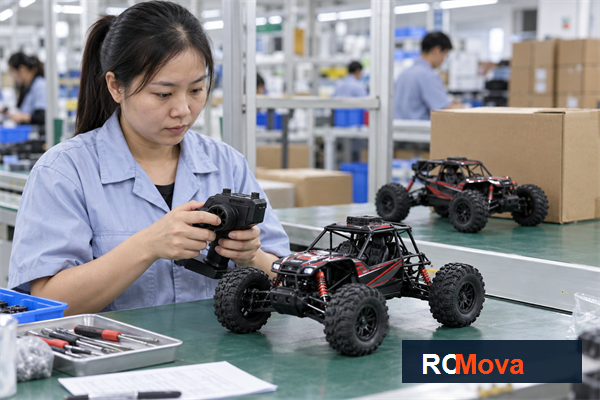
Article hero image — After the opening section
Image title: RC Toy Wheel Runout and Straight Tracking Checks — RC toy sourcing overview
Caption: Function checks and inspection records help keep an approved configuration consistent before packing. Article focus: rc toy wheel runout.
ALT text: Asian quality inspector testing an RC vehicle at a Shenzhen factory inspection bench; rc toy wheel runout buyer guide
Image size: 600 × 400 px
AI photography prompt: Documentary commercial photography for RC Toy Wheel Runout and Straight Tracking Checks, realistic RC toy products and Shenzhen factory setting, Asian staff if people appear, natural light, authentic details, no invented certificates, no text overlays, 3:2 landscape
In-article supporting image — Before the FAQ section
Image title: RC Toy Wheel Runout and Straight Tracking Checks — RC toy quality and shipment check
Caption: Production review for rc toy wheel runout before the export handoff.
ALT text: Asian quality team reviewing rc toy wheel runout with a remote control toy at the factory
Image size: 600 × 400 px
AI photography prompt: Realistic editorial photography showing a buyer checking rc toy wheel runout against an RC toy sample and shipment records, Asian staff if people appear, natural industrial lighting, no text or fabricated logos, 3:2 landscape
Frequently Asked Questions
What should buyers check first about define the driving setup?
Use a clean, level and repeatable surface with a stated lane length and vehicle starting position. Carpet pile, tile joints and floor slope can change the path of a lightweight RC toy. Record battery state, controller trim and speed mode. Decide whether the check uses a brief forward run, forward and reverse, or a model-specific routine. The method should be practical for the product category and not imply precision expected from a different grade of vehicle.
How should buyers verify check chassis and suspension symmetry?
Compare ride height, axle seating, arms, springs and body interference left to right. A warped chassis or incorrectly seated component can load one wheel differently. Confirm that decorative body parts do not rub during steering. If suspension is intentionally asymmetric for design reasons, document the expected condition. A dimensional check should reference controlled points and tolerances rather than an arbitrary measurement from an uneven body shell.
What should be confirmed before shipment?
Define observable failure examples and a sampling routine tied to the approved vehicle grade. Inspectors need enough lane space and consistent preparation. Record the number tested, surface and outcome. A single drifting unit should trigger defect classification and escalation under the agreed plan, not an improvised order decision. Keep photographs or video for disputes, while recognizing that lens angle can distort apparent wheel movement.
Conclusion: turn the decision into a working plan
Standardize the surface, battery and control setup, observe wheel rotation and path, then diagnose the component or assembly source before setting acceptance criteria. When the selected product, sample, documentation, inspection points and shipment handoff are visible, the buying team can move with greater confidence and fewer avoidable changes.
Send Your Requirements